Friday, June 24, 2011

NASA Mission Suggests Sun and Planets Constructed Differently

PASADENA, Calif. - Researchers analyzing samples returned by NASA's 2004 Genesis mission have discovered that our sun and its inner planets may have formed differently than previously thought.

Data revealed differences between the sun and planets in oxygen and nitrogen, which are two of the most abundant elements in our solar system. Although the difference is slight, the implications could help determine how our solar system evolved.


"We found that Earth, the moon, as well as Martian [...]


Full story at http://spacefellowship.com/news/art26049/nasa-mission-suggests-sun-and-planets-constructed-differently.html

Expendable Launch Vehicle Status Report

Spacecraft: Juno
Launch Vehicle: Atlas V-551 (AV-029)
Launch Site: Cape Canaveral Air Force Station, Fla.
Launch Pad: Space Launch Complex 41
Launch Date: Aug. 5, 2011
Launch Time: 11:39 a.m. EDT

At the Astrotech payload processing facility near Kennedy Space Center, Juno's flight software is being installed into the spacecraft's primary computer.

At Launch Complex 41, the last of five solid rocket boosters was attached to the Atlas booster on June 21. The Centaur upper stage will be [...]


Full story at http://spacefellowship.com/news/art26053/expendable-launch-vehicle-status-report.html

Russian Resupply Vehicle Docks to Station

The ISS Progress 43 spacecraft docked to the International Space Station at 12:37 p.m. EDT Thursday delivering three tons of fuel, air and supplies to the Expedition 28 crew. The unpiloted Russian resupply vehicle docked automatically to the aft port of the station?s Zvezda service module via the Kurs automated rendezvous system.

Flight Engineers Alexander Samokutyaev and Sergei Volkov monitored the docking of Progress 43 while at the controls of TORU, the Russian telerobotically operated  [...]


Full story at http://spacefellowship.com/news/art26056/russian-resupply-vehicle-docks-to-station.html

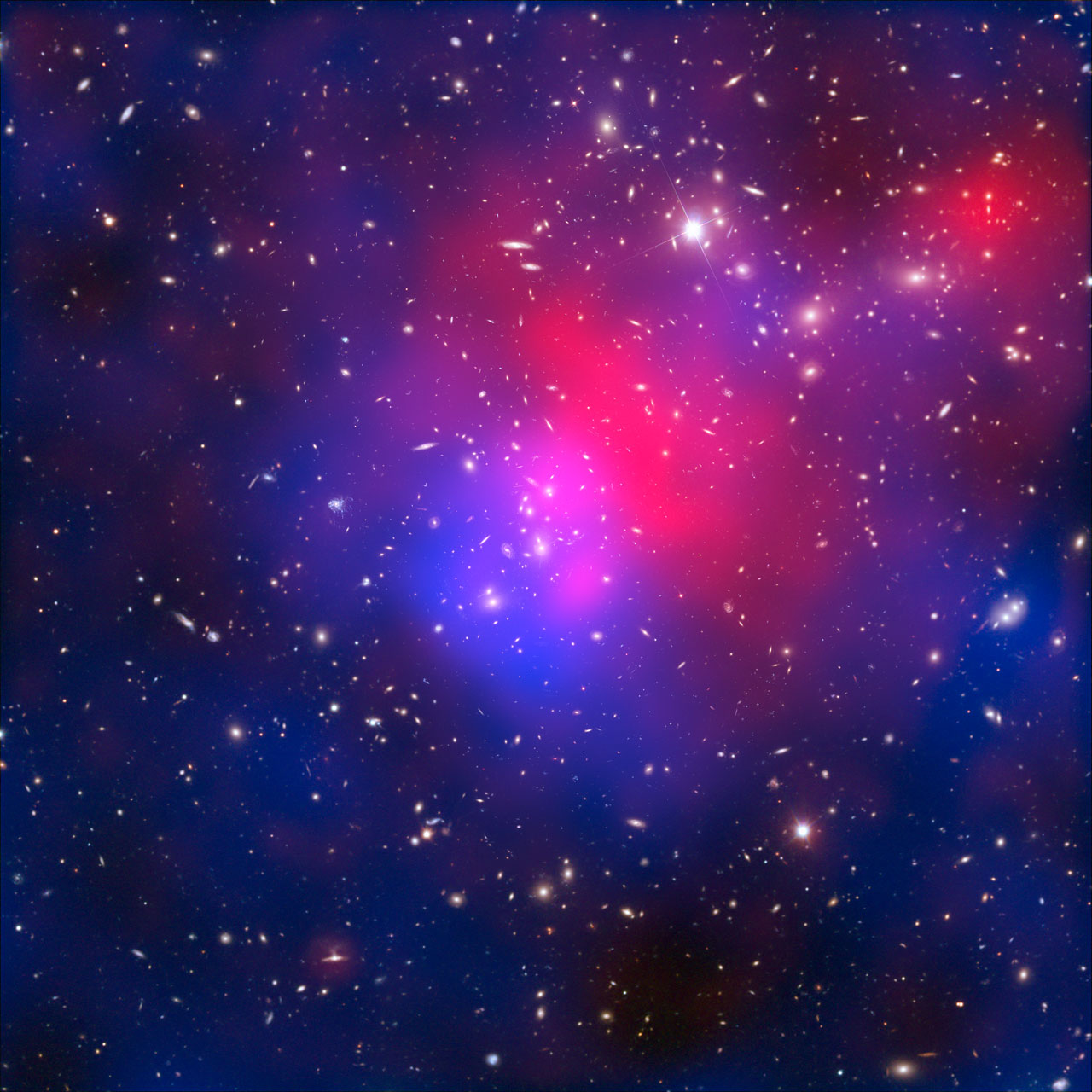
Opening the lid on Pandora?s Cluster

The largest structures in the Universe are superclusters: not just clusters of galaxies, but clusters of clusters. They can stretch for millions of light years and be composed of thousands of galaxies.


Abell 2744, at a distance from Earth of about 3.5 billion light years, is one such megastructure (if you want to sound fancy, astronomers call it "large-scale structure"). Astronomers have been studying Abell 2744 with an arsenal of telescopes, and have discovered that it’s actually the result of the ongoing collision of four galaxies clusters. If you’ve ever wondered what 400 trillion solar masses of material slamming into each other looks like, well, it’s more than a bit of a mess:


[Click to enclusternate.]


Yeah, like I said, it’s a mess.


First off, this picture is a combination of observations from Hubble (in visible light, colored blue, green, and red), the Very Large Telescope (also blue, green, and red), and the Chandra X-Ray Observatory (X-rays, colored pinkish). In visible light you can see literally hundreds of galaxies, probably more, dotting the supercluster. The pink glow is from very hot gas between galaxies; it started its life ...


Full story at http://feedproxy.google.com/~r/BadAstronomyBlog/~3/hbnr-yQG9Qs/

Thursday, June 23, 2011

ESA?s high-thrust engine takes next step

The new main engine to power Europe?s successor to its Ariane 5 space launcher was brought a step closer today when ESA signed a ?60 million contract with a propulsion consortium at the Paris Air & Space Show.

ESA is preparing the NGL Next-Generation Launcher to meet Europe?s institutional needs and safeguard its guaranteed access to space into the long term, ensuring it will continue to have effective and economic launchers at its disposal.


The work is being performed under  [...]


Full story at http://spacefellowship.com/news/art26032/esa-s-high-thrust-engine-takes-next-step.html

Cassini samples the icy spray of Enceladus' water plumes

The NASA/ESA/ASI Cassini-Huygens mission has directly sampled the water plumes jetting into space from Saturn?s moon Enceladus. The findings from these fly-throughs are the strongest evidence yet for the existence of large-scale saltwater reservoirs beneath the moon?s icy crust.

Enceladus? water plumes shoot water vapour and tiny grains of ice into space. They originate from the ?tiger stripe? surface fractures at the moon?s south pole, and create the faint E-ring, which traces th [...]


Full story at http://spacefellowship.com/news/art26035/cassini-samples-the-icy-spray-of-enceladus-water-plumes.html

Station Crew Prepares for Progress, Looks Ahead to STS-135

A new Progress resupply vehicle launched Tuesday from Kazakhstan and will dock to Zvezda Thursday morning. The Progress 43 replaces Europe?s Automated Transfer Vehicle ?Johannes Kepler? (ATV-2).

The ATV-2 undocked Monday and fired its deorbit engines for the last time Tuesday afternoon. Loaded with trash and discarded gear, the ATV-2 entered the atmosphere over the Pacific Ocean for a fiery destruction.

As Expedition 28 awaits the new resupply vehicle, it continues international sc [...]


Full story at http://spacefellowship.com/news/art26041/station-crew-prepares-for-progress-looks-ahead-to-sts-135.html