


[Yes, that title is correct. Bear with me.]
I’ve seen the Orion Nebula approximately… well, how many times? Let’s see… um, carry the two… yeah, a gazillion times. You have too, probably, since to the unaided eye it appears as a star in the dagger hanging below Orion’s famous belt*. I’ve also seen it with binoculars and through telescopes ranging in size from dimestore junkers to a one-meter on a mountaintop. And yet, every new picture of it reveals something interesting… like this spectacular shot does:
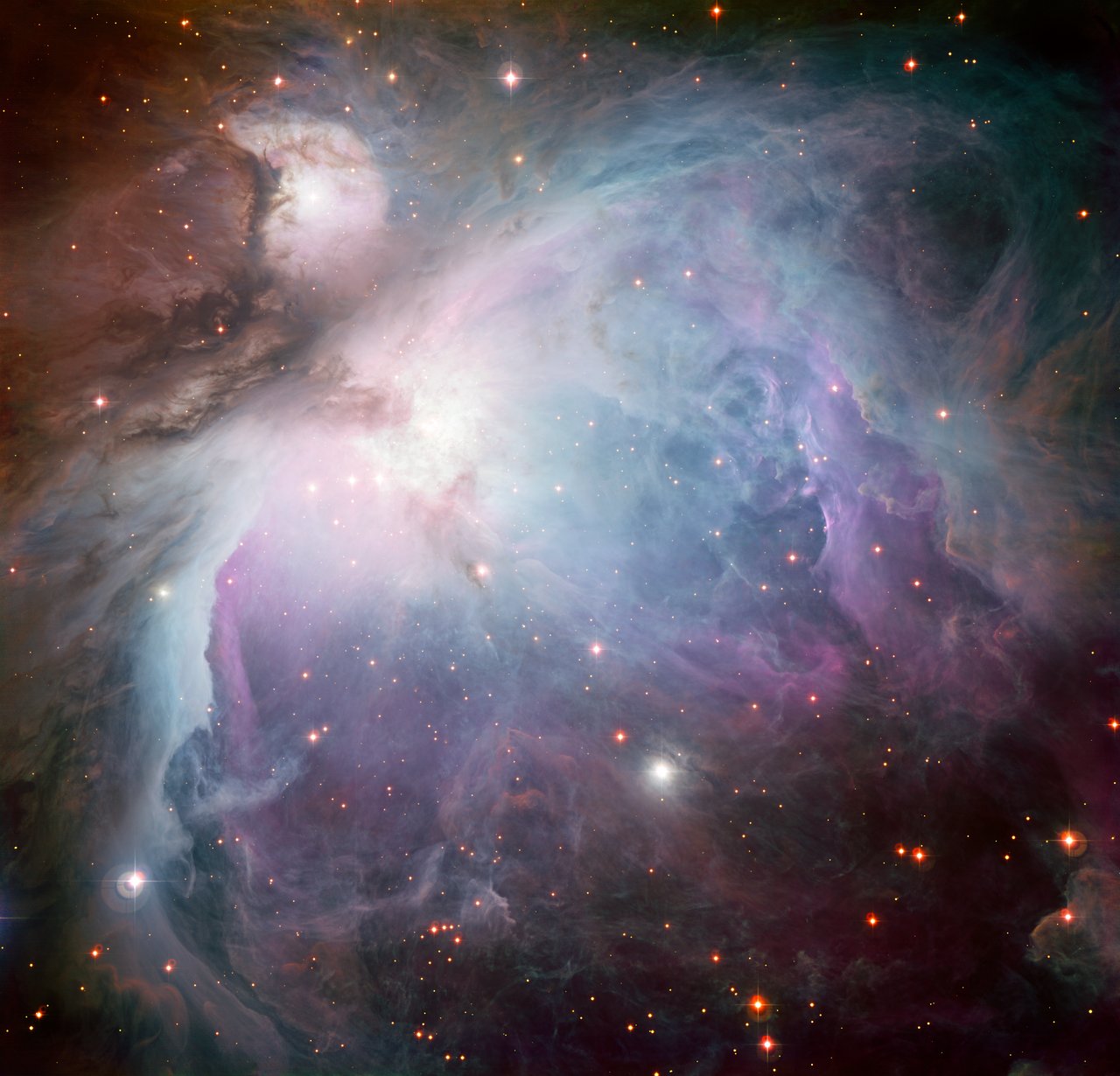
Yowza. Click to ennebulanate, or get the orionormous 4000 x 3800 version. Or you can treat yourself to the 142 Mb 9000 x 8600 pixel version!
First, some stats: this picture is a combination of five separate images from the red to the ultraviolet (that last colored violet, actually), including a filter that sees just the glow from warm hydrogen (colored red in this image). The telescope used was a 2.2 meter in Chile. The nebula is pretty big — the full Moon would just fit inside this image — so the detail on this is truly stunning.
The nebula is a vast cloud of gas, both atomic and molecular, and dust located about 1350 light years away. It’s one of the largest star forming factories in the Milky Way, and what you see here is well over 20 light years across.
For years I figured it was just a diffuse glowing thing in space, but it turns out to be more complicated than that. In reality, a lot of the nebula is actually a dark, dense molecular cloud — literally, composed of molecules like H2 (molecular hydrogen) and CO (carbon monoxide). This cloud is actually far, far larger than what you see in this image, perhaps 20 times the width! But it’s dark, so we don’t see it in visible light… and what we’re seeing in this picture is not really a free-floating gas cloud, but a cavity in the wall of the denser dark cloud.
Stars are being born inside that cloud. Some of them are very massive, hot, and bright. They blast out a fierce stellar wind, like the solar wind but far more powerful. They also emit a fierce flood of ultraviolet photons. Together, these two forces erode away at the material of the cloud, breaking apart the molecules into their constituent atoms, ionizing them, and causing them to glow. It so happens that some of these stars were born near the side of this cloud, so when they ate away the insides of the cloud it caused a blister in the side which burst open.
You can actually see that in this image! The bulk of the colorful nebula, from the upper left on down, is actually gas inside this cavity set aglow. The far wall is opaque and dark, so you don’t see it here. But you can get a sense of the bubble-like nature of the nebula.
I always get a bit of thrill when I see a picture that makes the concave nature of the nebula apparent. It’s not clear from some photographs, depending on the filters used, but I can see it in this one. And an interesting thing; these weren’t new observations! Igor Chekalin found several images of the nebula in the European Southern Observatory archives as part of their Hidden Treasures contest, and put them together to create this new image.
See? My title really was correct.
And oh, about that contest; amazingly, this image didn’t win. What did? An image of another nebula in Orion called M78… put together by Igor Chekalin!
Image credit: ESO and Igor Chekalin
* My roommate in grad school questioned the taxonomy of it being a "dagger", ifyouknowwhatImean winkwinknudgenudge saynomore.


Full story at http://feedproxy.google.com/~r/BadAstronomyBlog/~3/ZFtsHveNsPs/


 Posts
Posts


No comments:
Post a Comment